1 July 2026 07:00PM
Try to describe her, but above all, try to bring her back to life.
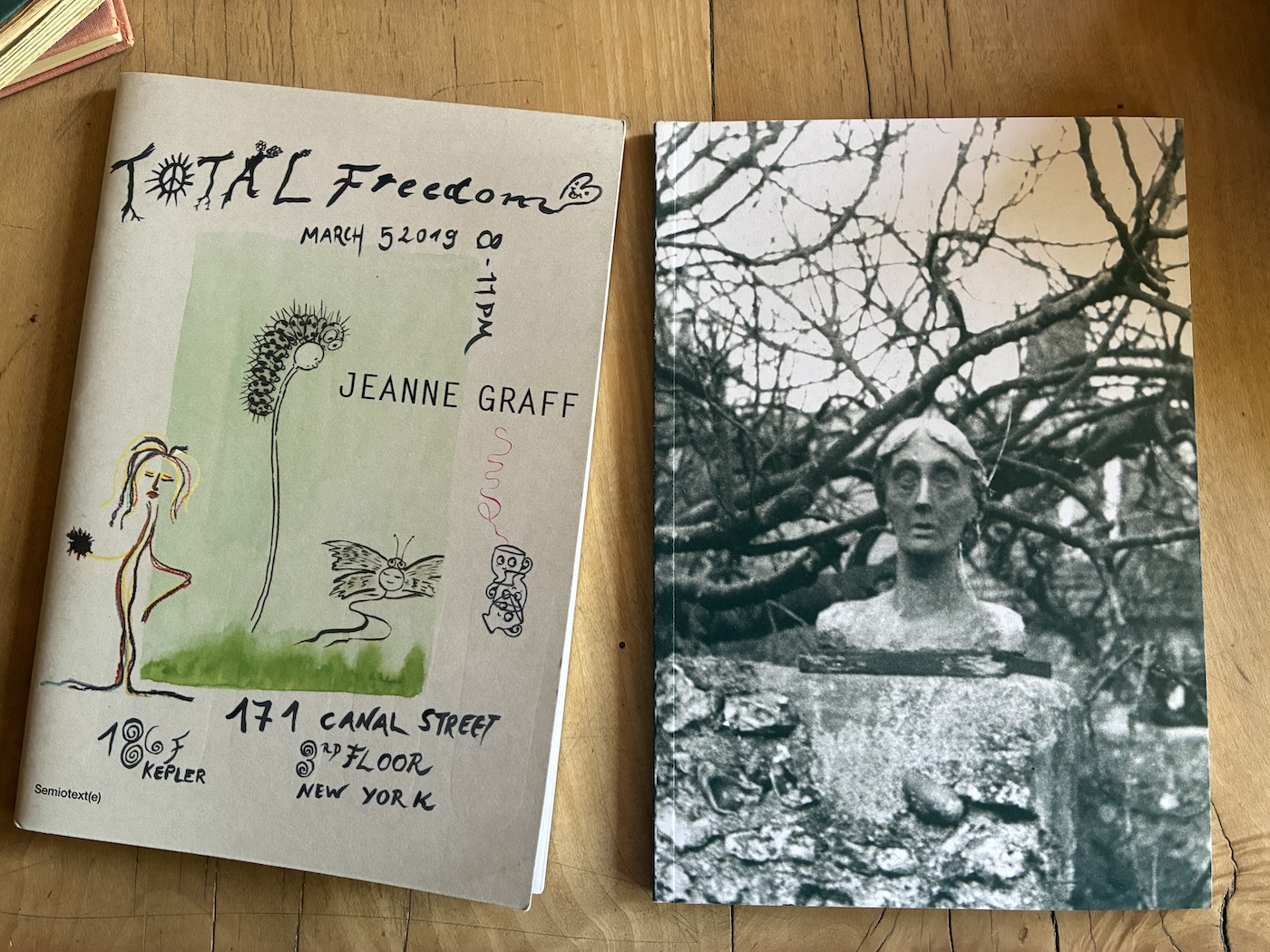
You’re warmly coolly invited to readings of On Virginia Woolf: Sylvère Lotringer’s Interviews with members of the Bloomsbury Group by Jeanne Graff & Constance Debré, and of Graff’s Total Freedom – two chapbooks published by Semiotext(e).
But what is this Virginia Woolf book?
In April 1961, while on a student-exchange year in Scotland, Sylvère Lotringer proposed to cover the 20th anniversary of Virginia Woolf’s death for the Parisian literary monthly Les lettres françaises. Riding by Vespa to London, Hilton Hall, and Sissinghurst Castle, Lotringer sought out a who’s who of Woolf’s living contemporaries from the Bloomsbury group—the early 20th-century modernist literary circle of which she was “essentially the essence,” as T. S. Eliot fondly reminisces here. In addition to Eliot, Lotringer interviewed Woolf’s husband Leonard Woolf, with whom he would become close, and the authors David Garnett and Vita Sackville-West. “What I’d really like to get across is her exquisite personality,” Sackville-West, the very inspiration for Woolf’s character Orlando, intimated to Lotringer. “She terrified everyone.”
Just 22 at the time, Lotringer would go on to complete a doctoral dissertation on Woolf, supervised by Roland Barthes and Lucien Goldmann, before moving to the United States in 1972 and subsequently founding Semiotext(e). For the first time ever, On Virginia Woolf publishes Lotringer’s interview transcripts (and documentary photographs) from 1961, all of which editor Jeanne Graff rediscovered among his papers at NYU’s Fales Library and devotedly transcribed in 2024. This book is a poetic tribute from Graff to her late friend and mentor; a portrait of Lotringer as a young intellectual, cultivating the art of the interview; and a unique addition to scholarship on Virginia Woolf.
And what about Total Freedom ?
JIM FLETCHER: Total Freedom feels different from Vzszhhzz because your writing is so affected by the time that it’s happening in, and this is a different time.
JEANNE GRAFF: When I read it again, I’m even surprised myself of what the story is. . . . It’s like, how can you explain how you make art, you know? We live our life, and then we chat we discuss, and then pouf, there is a piece of art. I love how Kembra speaks about it: I’m gonna do an artwork OK so here is the art supplies and here is the wall. That’s it. That’s how you make art, right? The thing is, our entire life is art, so suddenly you just produce something, no?